
Our Lady to Pedro Regis on July 30th, 2022:
*The transcription of a 1969 radio broadcast with Cardinal Joseph Ratzinger (Pope Benedict XVI) predicting a Church that will be simplified again…
“The future of the Church can and will issue from those whose roots are deep and who live from the pure fullness of their faith. It will not issue from those who accommodate themselves merely to the passing moment or from those who merely criticize others and assume that they themselves are infallible measuring rods; nor will it issue from those who take the easier road, who sidestep the passion of faith, declaring false and obsolete, tyrannous and legalistic, all that makes demands upon men, that hurts them and compels them to sacrifice themselves.
To put this more positively: The future of the Church, once again as always, will be reshaped by saints, by men, that is, whose minds probe deeper than the slogans of the day, who see more than others see, because their lives embrace a wider reality. Unselfishness, which makes men free, is attained only through the patience of small daily acts of self-denial. By this daily passion, which alone reveals to a man in how many ways he is enslaved by his own ego, by this daily passion and by it alone, a man’s eyes are slowly opened. He sees only to the extent that he has lived and suffered.
If today we are scarcely able any longer to become aware of God, that is because we find it so easy to evade ourselves, to flee from the depths of our being by means of the narcotic of some pleasure or other. Thus our own interior depths remain closed to us. If it is true that a man can see only with his heart, then how blind we are!
How does all this affect the problem we are examining? It means that the big talk of those who prophesy a Church without God 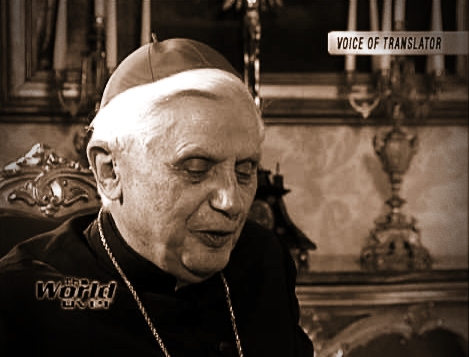 and without faith is all empty chatter. We have no need of a Church that celebrates the cult of action in political prayers. It is utterly superfluous. Therefore, it will destroy itself. What will remain is the Church of Jesus Christ, the Church that believes in the God who has become man and promises us life beyond death. The kind of priest who is no more than a social worker can be replaced by the psychotherapist and other specialists; but the priest who is no specialist, who does not stand on the [sidelines], watching the game, giving official advice, but in the name of God places himself at the disposal of man, who is beside them in their sorrows, in their joys, in their hope and in their fear, such a priest will certainly be needed in the future.
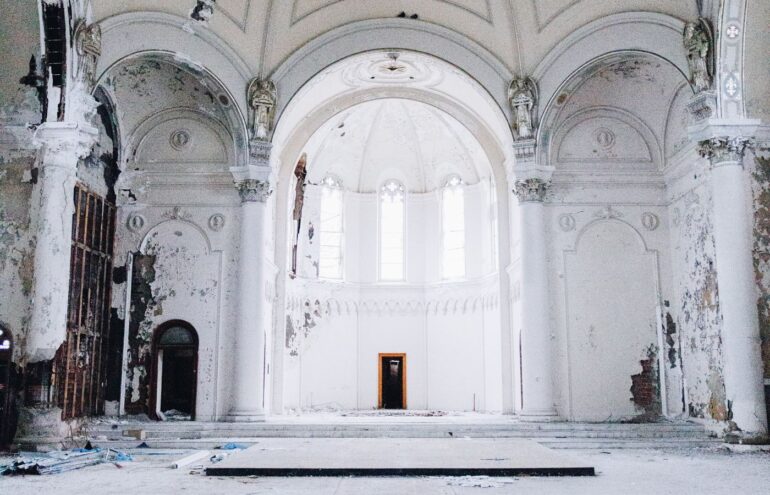
Let us go a step farther. From the crisis of today the Church of tomorrow will emerge — a Church that has lost much. She will become small and will have to start afresh more or less from the beginning. She will no longer be able to inhabit many of the edifices she built in prosperity. As the number of her adherents diminishes, so it will lose many of her social privileges. In contrast to an earlier age, it will be seen much more as a voluntary society, entered only by free decision. As a small society, it will make much bigger demands on the initiative of her individual members. Undoubtedly it will discover new forms of ministry and will ordain to the priesthood approved Christians who pursue some profession. In many smaller congregations or in self-contained social groups, pastoral care will normally be provided in this fashion. Along-side this, the full-time ministry of the priesthood will be indispensable as formerly. But in all of the changes at which one might guess, the Church will find her essence afresh and with full conviction in that which was always at her center: faith in the triune God, in Jesus Christ, the Son of God made man, in the presence of the Spirit until the end of the world. In faith and prayer she will again recognize the sacraments as the worship of God and not as a subject for liturgical scholarship.
The Church will be a more spiritual Church, not presuming upon a political mandate, flirting as little with the Left as with the Right. It will be hard going for the Church, for the process of crystallization and clarification will cost her much valuable energy. It will make her poor and cause her to become the Church of the meek. The process will be all the more arduous, for sectarian narrow-mindedness as well as pompous self-will will have to be shed. One may predict that all of this will take time. The process will be long and wearisome as was the road from the false progressivism on the eve of the French Revolution — when a bishop might be thought smart if he made fun of dogmas and even insinuated that the existence of God was by no means certain — to the renewal of the nineteenth century.
But when the trial of this sifting is past, a great power will flow from a more spiritualized and simplified Church. Men in a totally planned world will find themselves unspeakably lonely. If they have completely lost sight of God, they will feel the whole horror of their poverty. Then they will discover the little flock of believers as something wholly new. They will discover it as a hope that is meant for them, an answer for which they have always been searching in secret.
And so it seems certain to me that the Church is facing very hard times. The real crisis has scarcely begun. We will have to count on terrific upheavals. But I am equally certain about what will remain at the end: not the Church of the political cult, which is dead already, but the Church of faith. It may well no longer be the dominant social power to the extent that she was until recently; but it will enjoy a fresh blossoming and be seen as man’s home, where he will find life and hope beyond death.” —ucatholic.com

 Why Pedro Regis?
 Alicja Lenczewska
 Elizabeth Kindelmann
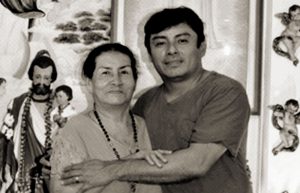
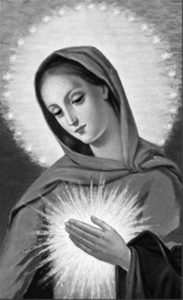 Through what became The Spiritual Diary, Jesus and Mary taught Elizabeth, and they continue to instruct the faithful in the divine art of suffering for the salvation of souls. Tasks are assigned for each day of the week, which involve prayer, fasting, and night vigils, with beautiful promises attached to them, laced with special graces for priests and the souls in purgatory. In their messages, Jesus and Mary say that The Flame of Love of the Immaculate Heart of Mary is the greatest grace given to mankind since the Incarnation. And in the not-so-distant future, her flame will engulf the entire world.
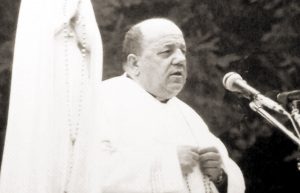 Father Stefano Gobbi
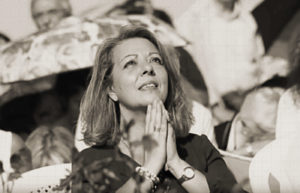 Why Gisella Cardia?
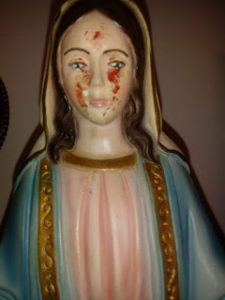 Thirdly, the messages have frequently been accompanied by visible phenomena, photographic evidence found in In Cammino con Maria, which cannot be the fruit of subjective imagination, notably the presence of the stigmata on Giselle’s body and and the appearance of crosses or religious texts in blood on Gisella’s arms. See the pictures taken from her apparition website
 Jennifer
 Why Manuela Strack?
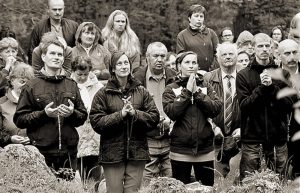
 Why the Visionaries of Our Lady of Medjugorje?
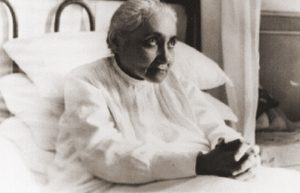 Why the Servant of God Luisa Piccarreta?
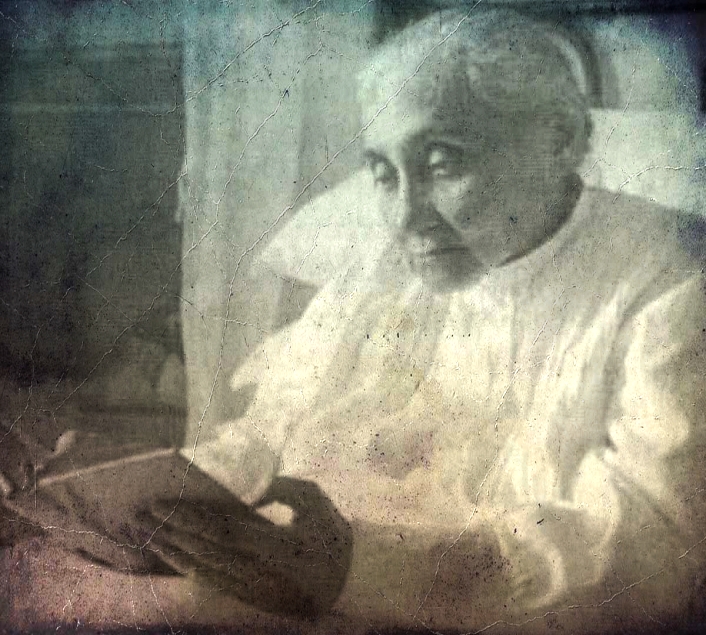 of the saints. It wasn’t until she became a “Daughter of Mary” that the nightmares finally ceased at the age of eleven. In the following year, Jesus began to speak interiorly to her especially after receiving Holy Communion. When she was thirteen, He appeared to her in a vision that she witnessed from the balcony of her home. There, in the street below, she saw a crowd and armed soldiers leading three prisoners; she recognized Jesus as one of them. When He arrived beneath her balcony, He raised his head and cried out: “Soul, help Me!” Deeply moved, Luisa offered herself from that day on as a victim soul in expiation for the sins of mankind.
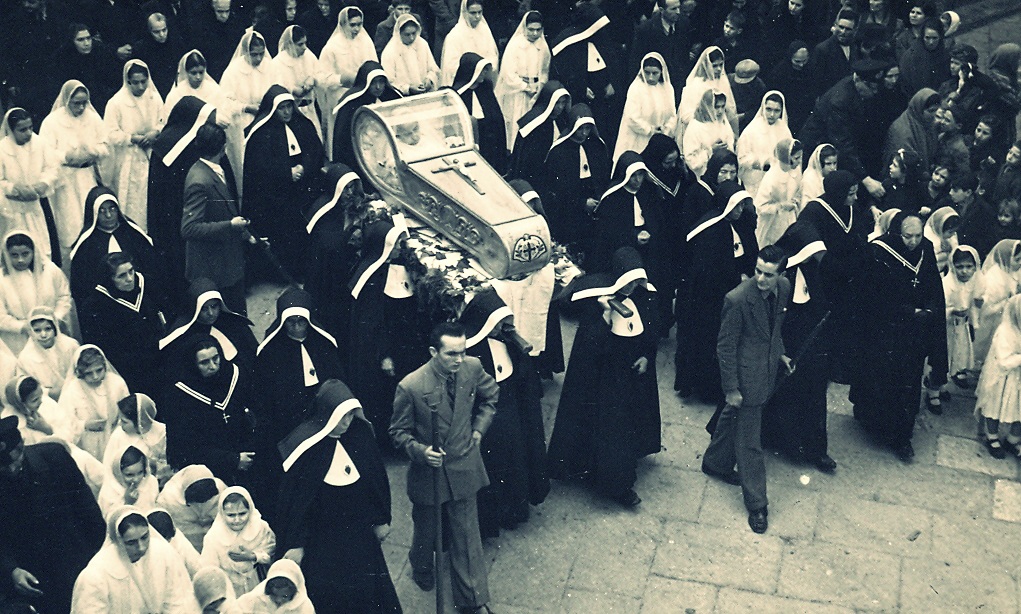 immobile, rigid-like state that appeared almost as if she were dead. It was only when a priest made the sign of the Cross over her body that Luisa regained her faculties. This remarkable mystical state persisted until her death in 1947—followed by a funeral that was no little affair. During that period in her life, she suffered no physical illness (until she succumbed to pneumonia at the end) and she never experienced bedsores, despite being confined to her little bed for sixty-four years.
 Why Simona and Angela?
 Valeria Copponi